Showing posts with label oxford. Show all posts

Friday, 4 April 2014

Literary festival part deux

Writers, if they are to be really successful, should be excellent verbal story tellers as well as able to paint pictures with their written words. I'm not sure if there are writers with subjects more opposed than Sebastian Barry and John Julius Norwich, but after hearing them speak, I am utterly convinced they share the gift of the gab (as the Irish might say) and the ability to keep their audiences spellbound.

Sebastian Barry's writing is deeply embedded in Ireland and the chaotic world of his family history; his drunken grandparents, his actress mother and poet father. He grew up thinking this chaos was all perfectly normal (as John Julius Norwich grew up believing it to be perfectly normal to have a mother as wildly charismatic as Diana Cooper). He's passionate about his heritage and answered every question Joan Bakewell put to him with an intensity of thought - even if he meandered down an avenue which had nothing to do with what he'd started to talk about. He read a section of his new novel 'The Temporary Gentleman' and I was completely blown away - not necessarily by the writing (which was dynamic and brilliant), but by his wonderfully dramatic delivery. As he read the description of a boat sinking having been torpedoed, the audience held its collective breath as the words tumbled about our ears and we were all transported to that sinking skip. I don't think I'll ever read one of his novels in the same way again and I'm convinced he should do public readings more often.

John Julius Norwich is a different type of storyteller, but just as captivating. He reminds me a little of a clockwork toy - wind him up and off he goes! He spoke for almost half an hour with hardly any interruption from his 'interviewer' Paul Blizzard, charting the intricate relationships of his family history and the locations his parents found themselves during World War II. He interrupted himself at one point to ask permission to read an extract of one of his Mother's letters. 'You do what you want John', Paul Blizzard chuckled, 'It's your show!' It really was. And his impersonations of Winston Churchill are spot on - not overblown, but done by someone who really knew him. Affectionate, but with an acknowledgement of the ridiculousness. 'Darling Monster' sounds like it will be treasure trove of letters, and will further serve to fuel my passion to continue the trend, rather than relying on email at all times.

The day was topped off in rather grand fashion with Philip Pullman, who introduced the music that has informed his life, played by the Orchestra of St John's. The pieces he chose were:

- Mendelssohn: Octet, 1st movement
- Shostakovich: Piano Concerto No 2, 2nd Movement
- Mozart: Void Che Sapete
- Bach: Italian Concerto BWV 971, 1st Movement
- Monteverdi: Si Dolce Il Tormentor
- Hellmann: Away we trot
- Beethoven: Song Er schwur es mis brim
- Debussy: En bateau from Petite Suite
- Brahms: Sextet Op. 18, 2nd movement
- Schubert: Heidenroslein; An Sylvia
- Ellington: Take the A Train
- Tchaikovsky: Serenade for strings, 4th Movement

Mostly familiar composers, but many pieces I'd never heard. I will look them up again though, and a trip to YouTube might be well worthwhile.

Philip Pullman never talks much about his own writing process, but he did reveal he had to work in silence (so much so that he had a shed built in the garden when his son took up the violin) and he is in the middle of a long awaited companion piece to the 'His Dark Materials' trilogy called 'The Book of Dust'. I can hardly wait.

Sunday, 30 March 2014

Literary festivals inspire

It's high time I got back into blogging. Life can be crazy busy at times and when you combine it with the fact I've not been reading that much because I've been a bit depressed, there didn't seem much worth writing about. 

Note that I've tried to qualify my feelings - although it's the worst I've ever felt, I'm fully aware it comes nowhere near what others suffer.

Anyway - the point is that life has now turned a corner and I want to write again.

It's literary festival time here in Oxford [or it was when I wrote this in a coffee shop. It's now Sunday, and the festival is pretty much over] so off I went to see Jan Morris. I feel the need to make a disclaimer: writing about Jan Morris is hard, not least because the use of sexual pronouns could become confused. The fact Jan Morris used to be a man (James) is probably one of the better known facts, but it doesn't help with the quandry of how to label her (him) when talking about events in the past when she was a he ... To avoid confusion, I plan to use the feminine pronoun throughout.

In a shockingly third full Sheldonian, Jan Morris took to her stage and immediately set about charming her audience with a story about her arrival earlier in the day. Sponsored as the festival is by the Folio society, the goodie bag participants receive naturally includes one of their books. And they are heavy. 'I'm not a great fan of short stories' she said as she revealed her book had been the collected short stories of V.S. Pritchett. Stopping to chat to one of the female porters at the gate of Christ Church, she reminisced that she was the longest serving member of the 'house', having become a chorister in 1936 at the age of ten. She then came to the college to study and is now an honorary fellow. 'And in recognition of this fact' she finished, with a gleeful anticipation of the punchline to come, 'I would like to bequeath this book to the college', and promptly handed over the Pritchett to a no doubt slightly baffled porter.

The thing I love perhaps more than anything about this story is the fact Jan Morris managed to get one over on the traditional history of Oxford. True, she was a man when she went to Oxford, but that still doesn;t alter the fact she is the first female alumni of Christ Church, some 30 years before they 'officially' admitted women.

This set the tone for the rest of the event. Designed, as it was, to be a kind of retrospective, the conversation flitted across topics such as Welshness, the Monarchy, how she writes and whether it comes fully formed (thankfully, she does three drafts before she considers it finished), climbing Everest and the state of England. 

Climbing Everest was the shock for me. When she started talking about that, I imagined this to be after the sex change and was preparing to hear stories of how she was the first woman to do so, etc ... but no! Jan Morris was the Times correspondent which accompanied the party led by Sir Edmund Hillary, who reached the summit on the same day as Elizabeth II's coronation. She has therefore been part of the anniversary celebrations ever since.

I've never read any of Jan Morris's work and am therefore unable to say whether the writing matches the character of the woman - strong and opinionated, but also very aware of herself. The interviewer (Kevin Crossley-Holland) did make reference to her beautiful prose, and we were lucky enough to hear extracts read aloud by Jan herself (simply because she felt like it, it seemed) which proved this instantly. The extract of her meeting a monk high in the Himalayas on a solitary ramble during the Everest expedition was startlingly evocative, powerful and intensely moving. I look forward  to delving into her work as soon as I can.

She did drop a bombshell with the fact that this would be her last public appearance, simply because she finds the preparation and the performance of events too exhausting now. At 87, who can blame her. It does make the empty Sheldonian that much more heartbreaking though. When I planned this piece, I was inclined to blame the marketing, and I am still persuaded that the organisers would be better served in sending out the hard copy earlier. However, now that I have been to a number of events, most of which were packed out, I think the price of tickets are to blame. £11 is expensive enough, but the Sheldonian tickets went up to £50, which is extortionate. Especially if you end up buying books after the event!

To finish on a positive note - although I have come to Jan Morris late in her career, I feel that I am surely going to devour all her works in the future. She signed my copy of 'A Writer's World' and added 'Bon Voyage!' when I told her of my plans. For here is my real reason for taking up the reigns of blogging again. Five years working in one place has show me, above all, that just being an administrator is not enough for me. I want to create too, and with that in mind, I've accepted a place on the MA in History of Art at the University of Birmingham. To aid with the transition between working and student, I'm taking two months to travel around Italy. This blog, therefore, will become a travel journal, and after that document the wonders of the art world into which I am fully immersing myself. All change!

Tuesday, 9 August 2011

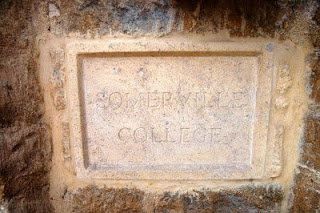
Somerville

Oxford can be a strange place. The University is, without a doubt, famous and draws many people to visit it's streets each year,* but it's identity is very much in the hands of the person describing it. Is it town or gown? Is it a place of great learning, or an old market town that has grown with the years? It is many things to many people.
I have always been conscious of the University part of the town, although until I went away to University, the colleges always seemed to be separate from me. I never went in them - indeed I hardly ever wanted to. They were just courtyards with briefly glimpsed gardens and I was quite content with that. I gradually started to move inside the warm stone of the outer walls: A series of concerts at The Queen's College, the literary festival at Christ Church, showing visitors Merton, but it wasn't until 2009 that the two sides of Oxford finally merged into each other. In 2009, I went to work for Somerville College.

The history of Oxford colleges is long and complicated. Balliol, Merton and University College were the first founded (and dispute amongst themselves over which came first) and thus a long tradition was established, finishing with Kellogg in 1990 (although Green and Templeton merged in 2008). Quite a few colleges have rivalries - I was told during my induction that the rivalry between Balliol and Trinity (who stand back to back) is particularly intense, and there are frequent proofs of this in the university papers and other little battles (apparently Balliol's tortoise, who was born the year Queen Victoria died, was stolen by Trinity at one point ....)

So, leaving these fascinating rivalries to one side, I shall take you back to a time when Oxford as a place of education was the haunt only of men. It wasn't that long ago, either. In the early 1870s, the wives of the dons** (and their daughters, and indeed women's suffrage campaigners as a whole) were getting restless. They wanted the chance to study the things their husbands taught, and believed themselves perfectly capable of study (contrary to popular opinion at the time). Things came to a head, after almost a decade of classes and public lectures, in 1878 when the proposal to form a permanent hall of study for women was agreed and Lady Margaret Hall (LMH) came into existence.


Yes, I know, this doesn't seem to have anything to do with the college I intended talking about, but believe me, the reference to LMH is entirely relevant to the way in which Somerville came to exist, because out of LMH's restrictions, we were born. LMH (named after Lady Margaret Beaufort (Henry VII's mother)) was opened to the daughters of Protestant families only. A group of men and women (including T.H. Green and Mary Ward (Thomas Arnold's daughter)), who had long since campaigned for women to be allowed to study at Oxford, were opposed to this restriction, believing that if education was to be offered to women in the first place, there ought to be no restrictions placed on eligibility. To this end, in 1879, with the spirit of non-denominationalism and openness being the driving force behind its inception, Somerville was founded and moved into a property on the Woodstock Road.


The name of the college is an interesting choice, as rather than choosing a religious link (Trinity, St John's, Jesus) or powerful benefactor (Balliol, Wadham, Merton), the college was named after a renowned female scientist, who had died in 1872, Mary Somerville. An ideal role model for the higher education of women, Mary had taught herself science from her brother's textbooks, her father believing that the female frame was not robust enough to cope with the demands of learning. She proved him wrong, without a doubt, and was so well respected that her book 'The Mechanics of the Heavens' was used as a textbook in Cambridge 50 years before the college was even thought of.

The life of of an Oxford female undergraduate was not without its trials. Although officially allowed to attend the University, they were only permitted to attend lectures when accompanied by a another female student or chaperone. It was not until 1920 that women were permitted to actually take the degree for which they had studied so hard. Another restriction has actually served Somerville quite well: for when women were first admitted to the University, they were not permitted to use the facility of the Bodleian at all (whether they had chaperones or not). This meant that the college was required to make its own arrangements and the library is now the second largest, with over 120,000 titles. It's also stunningly beautiful, which helps!


When one thinks of Oxford colleges, the immediate images that come to mind involve cloisters, students in black gowns, Morse and Harry Potter. If you were to stop the average person on the street, they might term the place 'stuffy'. This is an image that Somerville works hard to refute. Openness is one of the predominant characteristics of the College - not for us the secret cloisters known only to the special few, or the grass so revered it is not to be stepped on. Somerville's lawns once played host to tennis games and a donkey, and are now the ideal place in Summer for tutorials. Like many colleges, the site was requisitioned during both wars, and soldiers (including Siegfried Sassoon and Robert Graves) recuperated beneath the shady trees on the main quad. Our location has been considered awkward (although not being bang in the centre has its positives, being therefore less on the tourist trail) but it complements our ethos, as whilst we are rich in history, we also rub shoulders with the vibrant communities of Jericho and Little Clarendon Street. Cardinal Newman and Gerard Manley Hopkins preached on our doorstep (we are, ironically for our non-denominational standpoint, next door to the Catholic church) whilst our back gate leads directly to the bohemian bookshops and cinema that help keep a studious soul fresh and lively.


Somerville has always been a welcoming place, and in 1994 it finally opened its doors to men. Admittedly rather late in this aspect of Oxford history (the first women were admitted to previously all male colleges in 1974, and LMH celebrated its centenary by going co-educational), we made up for it by admitting pretty much equal numbers of men and women from the beginning. Being told on the potential pitfalls men could bring, the college was advised that men would eat more food and break more furniture. Perhaps that's why the bike shed was turned into a gym!

Like any other college, we are proud of our students and alumni, always wanting to know where they are, and what they've done. Ever since the college's inception it has produced ground breaking and pioneering women who have helped prepare the way for their successors. Cornelia Sorabji was not only the first female barrister in India, but she was also the first woman to read Law at Oxford (although admitted to read English, she impressed the dons and managed to persuade them to let her change her course); Dorothy Hodgkin (student and later tutor) became the first British woman to win the Nobel prize for science; Indira Gandhi and Margaret Thatcher became the first female prime ministers of their respective countries; Philippa Foot (Philosophy Fellow) was instrumental in setting up Oxfam; Shirley Williams followed in her mother's footsteps and honed her keen intellect within our walls.

Our artistic talent is prestigious too, for we can boast of many fine writers, including Vera Brittain, Winifred Holtby, A.S. Byatt, Iris Murdoch, Margaret Forster, Dorothy L. Sayers, Penelope Fitzgerald, Matthew Skelton and Kate Williams. Our male alumni are beginning to make a name for themselves, and already we can talk of an MP in Surrey East, an HR manager of Innocent Drinks, a playwright and a past winner of University challenge (who is also the first male student to have become a Somerville Fellow).

Much of my information comes from a book written by our former librarian (and Somervillian) Pauline Adams, 'Somerville for Women'. It's a truly rich source, and coupled with her trademark wit, makes for lively and interesting reading. On the rare occasions when the office is quiet enough for me to dip in to it, I have found some great pieces of information, which occasionally get dropped into the tours I do. For instance, it took four years for the chapel to be agreed upon and built, because the alumna who gave the money wanted it to be called Christ's House, which went against our non-denominational outlook, and once that was sorted out, there were further discussions on where it would be, and who would build it. Somervillians have never been known for being easy!

I could ramble on in this way for ages, sharing stories of the past, which have become an inspiration for the present. Every day I learn of new alumni to boast about (like the woman who was ordained in 1917 and became a congregational minister in the East End) or another story which fires my imagination (Dame Janet Vaughan (then Principal of College) requesting all the students here to have wine at dinner when Indira Gandhi became Prime Minister). Everything I learn helps to prove what a truly inspirational place Somerville is, and makes me want to share it with a wider audience.


*It is heavy tourist season at the moment .... you can tell, because the people that actually live here are walking in the road, the pavement being monopolised by a sea of well meaning, but very slow walking persons who stop every few seconds to take a photo. I shouldn't criticise - I do the same in Florence.
** That's tutors to those not familiar with Oxford jargon

Friday, 5 August 2011

Getting your money's worth

When you work in higher education, you become highly attuned to everything written on the subject. As the A levels release date comes ever closer, I can be sure of one thing: that when they are released, newspapers will claim three things: A levels are getting easier, it's becoming more expensive to study at university and Oxbridge are discriminating against state schools.
I don't know enough about the first to be able to comment properly, and I would likely go into rant mode if I were to try and discuss the third (although it's not true, by the way!); but the second observation is one that i can talk about - here goes!

It is no secret that university fees are going up astronomically. From 2012, many universities will be allowed to charge £9,000 for their degrees, and although many are putting support packages in place to provide for students who would otherwise struggle with this financial burden, the question still remains on how universities will be able to prove their courses are worth the money. Much has been said on teaching quality, research and lecture time for students, but one vital aspect appears - to my mind - to have been completely omitted from the discussion.
When I was at university (I did my undergrad at Keele and my MA at UEA in Norwich) my mother impressed upon me the need to visit the careers centre. I hardly ever did, for the very simple reason that they were rubbish. The staff never seemed very helpful and their layouts were ill organised and confusing. When i first started my current job in the academic office at Somerville College - part of Oxford University - I was invited, as part of my induction programme, to visit the University's Career service. What I saw there amazed and impressed me.
Real thought has gone into the layout of the rooms, so that a student can be guided through the various stages of thinking about and applying for jobs, so there's a section where one can get guidance on preparing a CV and covering letter, and once that's sorted, another section dedicated to every type of career - some I'd not even thought about. Of course the prestige of an Oxford education holds its own special significance and there are lots of summer internships available for those who are part way through their degrees. Each college has its own dedicated rep from the careers service who can come out and give help and advice to those who who are about to set foot into 'real life'. So much is offered and it truly is a great asset for the University.

The point I am trying to make (without letting my passion run away with me) is that with employment being as hard to obtain as it currently is, and with more and more companies requiring university education from their employees, the careers service is quickly becoming one of the more vital aspects of university life. To my mind, money should be invested in this service at every university, because the more help our students get, the quicker they grab hold of a job that pays well, then the better able universities will be to prove that spending the money was worth it, thereby ensuring higher education can continue for the next generation.

Hmmm .... I think I let my passion run away with my meaning! I'm slightly worried that I'm sounding snobby or elitist here, and I certainly don't mean to. I am more than aware that higher education is not for everyone - I certainly never agreed with the Labour party policy of a target of 50% in higher education. It always seemed to be such an arbitrary figure and something that might end up forcing those better suited to apprenticeships or vocational courses into a form of education that did not suit them.

I can't think of a decent way of wrapping up this post without getting overly passionate (and as I've just engaged in a heated discussion with my parents' next door neighbour about whether or not any arts degree is worth while - she thought not, and managed to term my entire 4 years at University as a 'Mickey Mouse degree' - I'd best not start ranting.) My main point is, as I'm sure you'll all have gathered, is that Oxford's careers service rocks, and other universities would be well served by using some of the £9,000 fees to improve theirs. It's the way forward - you heard it here first!

Wednesday, 3 November 2010

Oxford Thinking

One of the pleasures of working for Oxford University is the access it gives those that work for it to intellectual stimulation. I've not been a student for some years, but I can still get a boost of learning whenever the mood takes me. There are always talks and lectures going on, and since the notices come through my office to display, I can take my pick.

Yesterday I found myself in the English faculty listening to a distinguished American lecturer discuss the theme of property in Richard II. i have to admit I felt a little out of place, amongst the various Oxford students, all armed with notepads and looks of serious intent, but once that had worn off, I settled back into the practise of listening and learning. Besides - if the conversations I overheard beforehand were anything to go by, Oxford students definitely don't spend all their time pontificating on their various subjects. there was a particularly intense conversation going on behind me about the timeline of origin of the words 'Aubergine' and 'Eggplant'.

Another thing I love about this job is the access it gives me to the tutors. Once a term there is an MCR/SCR symposium, where a graduate and a fellow of the college talk about their work and interests. Now, this can be hit and miss. An interesting subject does not necessarily translate into an interesting talk, should the minutiae become all encompassing. This is rare, however, and the evenings are generally eye opening.

Blogging has also started to make an appearance, and Somerville has recently seen two new enthusiastic bloggers creep out of the woodwork. The new Principal - Dr Alice Prochaska - has started commenting on the new role she has been thrust in to, with all its various duties, whilst History tutor, Dr Natalia Nowakowska, has created a blog that not only looks at her research work, but which also talks about Oxford life from the view of an academic.

I've created a little Oxford haven on the left side of my blog, where I will be putting the various blogs and places of interest that I come across. At this time of great upheaval in the higher education sector, I think it's important to show people every aspect of the world they may want to enter. It's not all about beautiful architecture and overwhelming work. There's a very human aspect too.

Sunday, 10 January 2010

Zuleika Dobson

There are a great many books that have been written that use Oxford as a centrepiece. Colin Dexter is the most obvious choice and in latter years Philip Pullman's trilogy have shown us the Oxford that is known and the one that lives just beyond reach in that other world.

There is another novel that has the backdrop of Oxford, and that is Zuleika Dobson by Max Beerbohm. It tells the story of a young woman (not strictly beautiful 'Her eyes were a trifle large ... The mouth was a mere replica of Cupid's bow ... she had no waist to speak of') who manages to capture the hearts of the entire host of undergraduates. Zuleika inspire affection in all but one, The Duke, and seeing this she instantly falls in love. However, the Duke realises this, declares his love and is promptly rejected by his amour. This causes him to declare he will throw himself in the river for love of her.
Now - this is all very well, one man dying for love, and you'd hope the woman being 'honoured' in such a way would immediately recant, or persuade him to change his mind. Not Zuleika. She sees it as the highest compliment, and The Duke accidentally manages to incite all the undergraduates to drowning with him. Thus ends Zuleika's brief spell in Oxford, and what does she feel at this this calamity? Remorse? Sadness? The need to sequester herself in a nunnery? None of these, I am afraid, rather an overwhelming desire to go to Cambridge ....... oh dear.

It has been a long running conversation over on Justine Picardie's blog about who would be the best person to play this inscrutable Miss Dobson should the book ever be filmed. I've been casting my mind over this problem, and feel that the following people would be great.

Katharine Hepburn or Bette Davis: If this film had been done in the 40s, then these two wonderful actresses could have swept off with any number of undergraduates they chose. Bette Davis would probably been harder hearted at the mass drowning.

Helena Bonham-Carter: Can't you just see her inspiring adoration everywhere she went? It's also a very eccentric role, which she would do to perfection.

Carey Mulligan - although perhaps to conventionally beautiful

Anna Maxwell-Martin

Anne-Marie Duff

There was a general thought that Lily Cole could do it very well, but personally I think she is too frail, a quality Zuleika definitely doesn't have! It's an interesting book, mad in places, but I love it. Has anyone else out there read it, and if so - who do you think could play the fascinating Zuleika?

Tuesday, 10 February 2009

Anyone for a fight?

Living in Oxford, you become extremely aware of persons walking about that are neither residents nor tourists. They are only there at certain times of the year, and for most of it, they stick to their own little courtyards. Except, of course, around May time, when they all pour onto the high st and stand nervously, dressed in formal black and white, holding a mortar board, outside the Examinations school, like a pack of especially clever penguins.

Yes, I am talking about students, and no, I didn't eat anything really strange for lunch.

Why, I can hear those who have got this far ask, am I talking about these people? Well quite simply because of an event that happened over 600 years ago.

On this date in 1355,
the St Scholastica’s Day riot began in Oxford, with opposing forces of town and gown going on the rampage for three days ... it seems even in the 1300s, those pesky students were getting in the way, and probably flaunting their brains in the faces of the farmers (sorry for the bad mental image I just conjured up!).

Something inside of me feels that the time is right for another Town V Gown - although without the violence. If we could all fight like Colin Firth and Hugh Grant in Bridget Jones, then it would all be ok! Simon - as the only Gown here in Oxford that I know - would you care to flap your hands in my general direction? I'm sure we'd be a great tourist attraction!

Wednesday, 21 May 2008

Ode to Oxford


Earth has not anything to show more fair, wrote Wordsworth - and although I know he was talking about London at the time, today is one of those days that I feel it could be applied just as well to Oxford.

I love this city so much. It's grand and glorious buildings in that soft stone, that when cleaned of the grime of centuries, are so warm and welcoming; the narrow winding streets between colleges, through which one can meander and hear various college sounds; the fact that with very little effort you can be out into the countryside, in a little known pub or village. I find it so magical that I can be looking at buildings like the one above almost every day.

Tonight I was privileged to view the Botanic Garden after it closed, and have a tour, learning a few things along the way. Did anyone know, for instance, that the man who caused it to come into being was actually a murderer? He wasn't prosecuted because in the 1600s it was legal to kill a man, if that man had killed your servant!
The lower part of the garden belonged to Merton (whilst the rest belonged to Magdalene), and was offered in the 50s, when it had been flooded many times - the rent was offered at 2 and 6, and those wise gardeners paid 100 years upfront! Just think how much rent that would be now!
We stood by a great black fir tree, which twisted it's way up to the sky, looking for all the world like it was about to shake it's branches and settle in some new position. This was the tree that Lyra and Will sat under in 'The Amber Spyglass' and promised to return to each year. But it was also Tolkien's favourite tree ... and truly it did look like if one sat under it for too long, it might try to swallow you up!

There are times, of course, that I dislike Oxford. When it's been raining for two long, and you think the water meadows are going to take over the city; or in the summer, when I wish that what Pullman wrote was true, and there was another city above this one, where we could banish all tourists and mothers with small children! But these are small and insignificant things, and pale in comparison with how much I love this city, and the joy and inspiration it gives me.